
1632 Series Reading Order
(aka the Ring of Fire series)
by Eric Flint
Whenever someone asks me “what’s the right 1632 series reading order?”, I’m always tempted to respond: “I have no idea. What’s the right order for studying the Thirty Years War? If you find it, apply that same method to the 1632 series.”
However, that would be a bit churlish—and when it comes down to it, authors depend upon the goodwill of their readers. So, as best I can, here goes.
The first book in the series, obviously, is 1632. That is the foundation novel for the entire series and the only one whose place in the sequence is definitely fixed.

The digital eBook edition of 1632 is available as a free download at Baen.com. Click here to get your free copy!
Thereafter, you should read either the anthology titled Ring of Fire or the novel 1633, which I co-authored with David Weber. It really doesn’t matter that much which of these two volumes you read first, so long as you read them both before proceeding onward. That said, if I’m pinned against the wall and threatened with bodily harm, I’d recommend that you read Ring of Fire before you read 1633.
That’s because 1633 has a sequel which is so closely tied to it that the two volumes almost constitute one single huge novel. So, I suppose you’d do well to read them back to back. That sequel is 1634: The Baltic War, which I also co-authored with David Weber.
Once you’ve read those four books—to recapitulate, the three novels (1632, 1633 and 1634: The Baltic War) and the Ring of Fire anthology—you can now choose one of two major alternatives for the 1632 series reading order.
The first way, which I’ll call “spinal,” is to begin by reading all of the novels in what I will call the main line of the series. As of now, the main line consists of these seven novels:
1632
1633 (with David Weber)
1634: The Baltic War (with David Weber)
1635: The Eastern Front
1636: The Saxon Uprising
1636: The Ottoman Onslaught
1637: The Polish Maelstrom
All of these novels except the two I did with David Weber were written by me as the sole author. The next main line novel, whose working title is 1637: The Adriatic Decision, I will be writing with Chuck Gannon. (Dr. Charles E. Gannon, if you want to get formal about it.) That novel probably won’t come out for a while, however, because there is a novel that have to be written first, in order to lay the basis for it.
I call this the “main line” of the Ring of Fire series for two reasons. First, because it’s in these seven novels that I depict most of the major political and military developments which have a tremendous impact on the entire complex of stories. Secondly, because these “main line” volumes focus on certain key characters in the series. Four of them, in particular: Mike Stearns and Rebecca Abrabanel, first and foremost, as well as Gretchen Richter and Jeff Higgins. ?
Join the Ring of Fire Mailing List!
Sign up to receive the latest news & announcements, upcoming book releases, convention updates, and more! We promise to never share your email address with anyone for any reason.Sign me up!
The other major alternative way to read the series is what I will call “comprehensive.” This approach ignores the special place of the main line novels and simply reads the series as an integral whole—i.e., reading each novel and anthology more or less in chronological sequence. (I’m referring to the chronology of the series itself, not the order in which the books were published. The two are by no means identical.)
The advantage to following the spinal way of reading the series is that it’s easier to follow since all of these novels are direct sequels to each other. You don’t have to deal with the complexity of reading all the branching stories at the same time. Once you’ve finished the main line novels, assuming you’re enjoying the series enough to want to continue, you can then go back and start reading the other books following the order I’ve laid out below.
The disadvantage to using the spinal method is that you’re going to run into spoilers. Most of the major political and military developments are depicted in the main line novels, but by no means all of them. So if spoilers really bother you, I’d recommend using the comprehensive approach.
All right. From here on, I’ll be laying out the comprehensive approach to the series. If you’ve decided to follow the spinal method, you can follow this same order of reading by just skipping the books you’ve already read.
Once you’ve read 1632, Ring of Fire, 1633 and 1634: The Baltic War, you will have a firm grasp of the basic framework of the series. From there, you can go in one of two directions: either read 1634: The Ram Rebellion or 1634: The Galileo Affair.
There are advantages and disadvantages either way. 1634: The Ram Rebellion is an oddball volume, which has some of the characteristics of an anthology and some of the characteristics of a novel. It’s perhaps a more challenging book to read than the Galileo volume, but it also has the virtue of being more closely tied to the main line books. Ram Rebellion is the first of several volumes which basically run parallel with the main line volumes but on what you might call a lower level of narrative. A more positive way of putting that is that these volumes depict the changes produced by the major developments in the main line novels, as those changes are seen by people who are much closer to the ground than the characters who figure so prominently in books like 1632, 1633, and 1634: The Baltic War.
Of course, the distinction is only approximate. There are plenty of characters in the main line novels—Thorsten Engler and Eric Krenz spring immediately to mind—who are every bit as “close to the ground” as any of the characters in 1634: The Ram Rebellion. And the major characters in the series will often appear in stories outside of the main line.
Whichever book you read first, I do recommend that you read both of them before you move on to 1634: The Bavarian Crisis. In a way, that’s too bad, because Bavarian Crisis is something of a direct sequel to 1634: The Baltic War. The problem with going immediately from Baltic War to Bavarian Crisis, however,is that there is a major political development portrayed at length and in great detail in 1634: The Galileo Affair which antedates the events portrayed in the Bavarian story.
Still, you could read any one of those three volumes—to remind you, these are 1634: The Ram Rebellion, 1634: The Galileo Affair and 1634: The Bavarian Crisis—in any order you choose. Just keep in mind that if you read the Bavarian book before the other two you will be getting at least one major development out of chronological sequence.
After those three books are read, you should read 1635: A Parcel of Rogues, which I co-authored with Andrew Dennis. That’s one of the two sequels to 1634: The Baltic War, the other one being 1635: The Eastern Front. The reason you should read Parcel of Rogues at this point is that most of it takes place in the year 1634.
Thereafter, again, it’s something of a toss-up between three more volumes: the second Ring of Fire anthology ( Ring of Fire II ) and the two novels, 1635: The Cannon Law and 1635: The Dreeson Incident. On balance, though, I’d recommend reading them in this order because you’ll get more in the way of a chronological sequence:
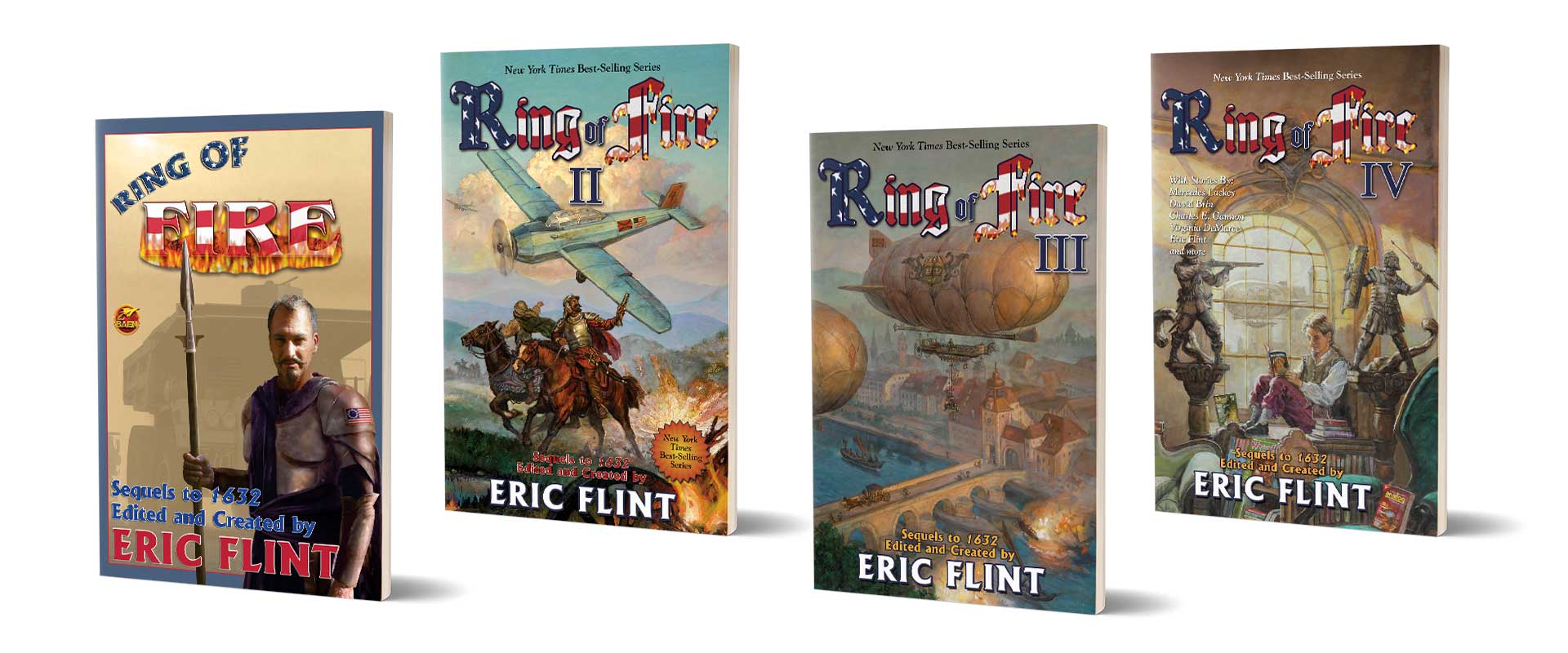
Ring of Fire II
1635: The Cannon Law
1635: The Dreeson Incident
The time frame involved here is by no means rigidly sequential, and there are plenty of complexities involved. To name just one, my story in the second Ring of Fire anthology, the short novel “The Austro-Hungarian Connection,”is simultaneously a sequel to Virginia’s story in the same anthology, several stories in various issues of the Grantville Gazette—as well as my short novel in the first Ring of Fire anthology, The Wallenstein Gambit.
What can I say? It’s a messy world—as is the real one. Still and all, I think the reading order recommended above is certainly as good as any and probably the best.
We come now to Virginia DeMarce’s 1635: The Tangled Web. This collection of inter-related stories runs parallel to many of the episodes in 1635: The Dreeson Incident. This volume is also where the character of Tata who figures in Eastern Front and Saxon Uprising is first introduced in the series.
You should then backtrack a little and read 1635: The Papal Stakes, which is the direct sequel to 1635: The Cannon Law. And you could also read Anette Pedersen’s 1635: The Wars for the Rhine.
You can then go back to the “main line” of the series and read 1635: The Eastern Front and 1636: The Saxon Uprising. I strongly recommend reading them back to back. These two books were originally intended to be a single novel, which I wound up breaking in half because the story got too long. They read better in tandem.
Then, read Ring of Fire III. My story in that volume is directly connected to 1636: The Saxon Uprising and lays some of the basis for the sequel to that novel, 1636: The Ottoman Onslaught. After that, read 1636: The Kremlin Games. That novel isn’t closely related to any other novel in the series—with the exception of its own sequel—so you can read it almost any time after reading the first few volumes. While you’re at it, you may as well read the sequel, 1637: The Volga Rules. You’ll be a little out of sequence with the rest of the series, but it doesn’t matter because at this point the Russian story line still largely operates independently.
Thereafter, the series branches out even further and there are several books you should read. I’d recommend the following order, but in truth it doesn’t really matter all that much which 1632 series reading order you follow in this stretch of the series:
1636: Commander Cantrell in the West Indies picks up on the adventures of Eddie Cantrell following the events depicted in 1634: The Baltic War.
1636: The Cardinal Virtues depicts the opening of the French civil war which was also produced by the events related in The Baltic War and which has been foreshadowed in a number of stories following that novel. 1636: The Vatican Sanction picks up the “Italian line” in the series, which follows the adventures of Sharon Nichols and Ruy Sanchez.
Iver Cooper’s 1636: Seas of Fortune takes place in the Far East and in the New World. The portion of it titled “Stretching Out” has a few spoilers to Commander Cantrell in the West Indies and vice versa, but nothing too important
1636: The Devil’s Opera takes place in Magdeburg and might have some spoilers if you haven’t read Saxon Uprising. My co-author on this novel, David Carrico, also has an e-book available titled 1635: Music and Murder which contains stories published in various anthologies that provide much of the background to The Devil’s Opera.
1636: The Viennese Waltz comes after Saxon Uprising in the sense that nothing in it will be spoiled by anything in Saxon Uprising but you might find out Mike’s whereabouts early if you read it first. On the other hand, the e-book 1636: The Barbie Consortium (the authors of which are Gorg Huff and Paula Goodlett) is a direct prequel to Viennese Waltz and should be read first if you want to be introduced to the young ladies dancing the Viennese Waltz.
1636: The Viennese Waltz is also one of the three immediate prequels to the next main line novel in the series, which is 1636: The Ottoman Onslaught. If you’re wondering, the other two immediate prequels are 1636: The Saxon Uprising and my short novel “Four Days on the Danube,” which was published in Ring of Fire III.
The next volumes in the 1632 series reading order you should look for are these:
Ring of Fire IV (May, 2016). There are a number of stories in this volume written by different authors including David Brin. From the standpoint of the series’ reading order, however, probably the most important is my own story “Scarface.” This short novel serves simultaneously as a sequel to The Papal Stakes and The Dreeson Incident, in that the story depicts the further adventures of Harry Lefferts after Papal Stakes and Ron Stone and Missy Jenkins following The Dreeson Incident.
1636: The Chronicles of Dr. Gribbleflotz, by Kerryn Offord and Rick Boatright (August, 2016). As with The Devil’s Opera, this is a story set in the middle of the United States of Europe as it evolves. In this case, relating the adventures of a seventeenth century scholar—a descendant of the great Paracelsus—who becomes wealthy by translating the fuzzy and erroneous American notions of “chemistry” into the scientific precision of alchemy.
Then you should return to the main line of the series by reading, back to back, my two novels 1636: The Ottoman Onslaught (January, 2017) and 1637: The Polish Maelstrom (March, 2019).
Following those two, read two novels that are “outliers,” so to speak. Those are 1636: Mission to the Mughals (April, 2017) and 1636: The China Venture (forthcoming November, 2019). Keep in mind that the term “outliers” is always subject to modification in the Ring of Fire series. Right now, those stories taking place in (respectively) India and China don’t have much direct connection to the rest of the series. But it’s a small world in fiction just as it is in real life, so you never know what the future might bring.
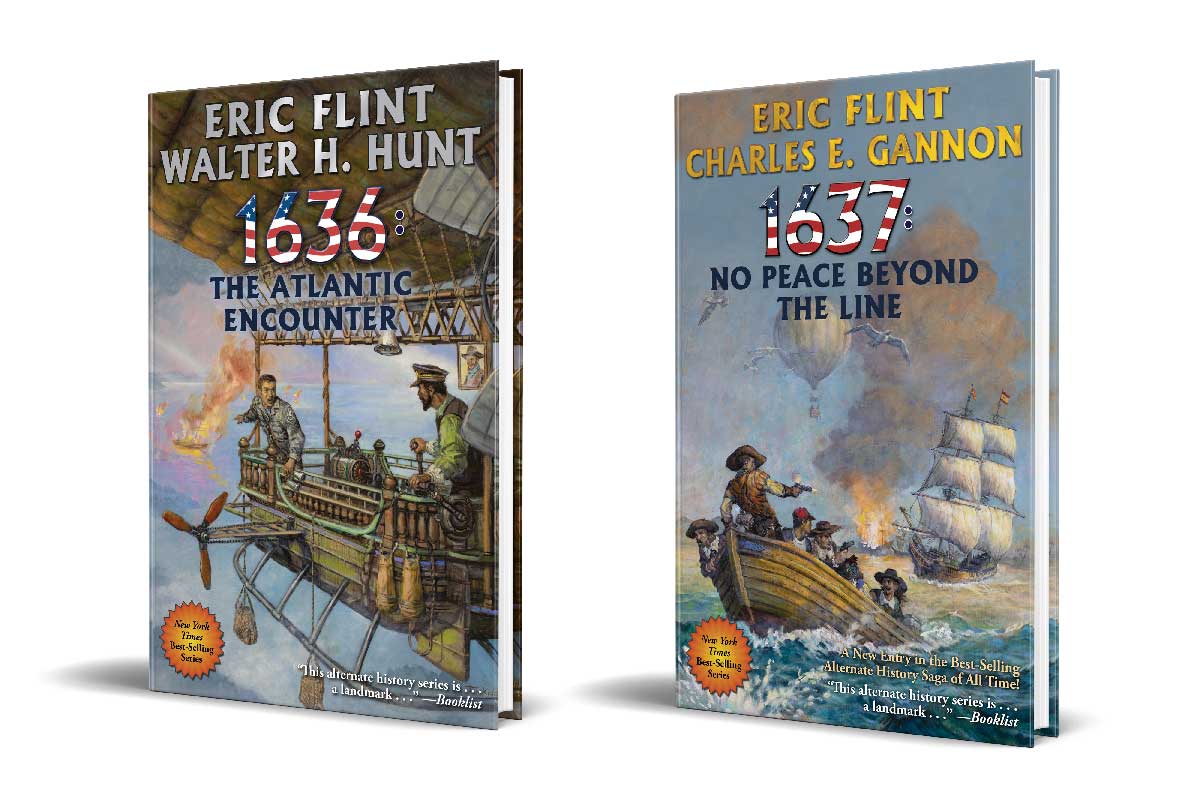
Finally—using the term very provisionally—read two novels that take place in the New World. The first is 1636: The Atlantic Encounter, with I wrote with Walter Hunt and which came out in August of this year. And the second is this one, 1637: No Peace Beyond the Line.
This brings us full circle. You may recall that toward the beginning of this afterword I said that the next main line novel required that another novel be written first. Well, that’s the novel you are holding in your hand. Chuck and I will start writing the next main line novel next year, which means it probably won’t come out until 2022.
That leaves the various issues of the Gazette, which are really hard to fit into any precise sequence. The truth is, you can read them pretty much any time you choose.
It would be well-nigh impossible for me to provide any usable framework for the eighty-two electronic issues of the magazine, so I will restrict myself simply to the eight volumes of the Gazette which have appeared in paper editions. With the caveat that there is plenty of latitude, I’d suggest reading them as follows:
Read Gazette I after you’ve read 1632 and alongside Ring of Fire. Read Gazettes II and III alongside 1633 and 1634: The Baltic War, whenever you’re in the mood for short fiction. Do the same for Gazette IV, alongside the next three books in the sequence, 1634: The Ram Rebellion, 1634: The Galileo Affair and 1634: The Bavarian Crisis. Then read Gazette V after you’ve read Ring of Fire II, since my story in Gazette V is something of a direct sequel to my story in the Ring of Fire volume. You can read Gazette V alongside 1635: The Cannon Law and 1635: The Dreeson Incident whenever you’re in the mood for short fiction. Gazette VI can be read thereafter, along with the next batch of novels recommended.
I’d recommend reading Grantville Gazette VII any time after you’ve read 1636: The Cardinal Virtues. And you can read Grantville Gazette VIII any time thereafter as well.
****
And… that’s it, as of now. There are a lot more volumes coming.
For those of you who dote on lists, here it is. But do keep in mind, when you examine this neatly ordered sequence, that the map is not the territory.
- 1632
- Ring of Fire
- 1633
- 1634: The Baltic War
- (Somewhere along the way, after you’ve finished 1632, read the stories and articles in the first three paper edition volumes of the Gazette.)
- 1634: The Ram Rebellion
- 1634: The Galileo Affair
- 1634: The Bavarian Crisis
- 1635: A Parcel of Rogues
- (Somewhere along the way, read the stories and articles in the fourth paper edition volume of the Gazette.)
- Ring of Fire II
- 1635: The Cannon Law
- 1635: The Dreeson Incident
- 1635: The Tangled Web (by Virginia DeMarce)
- (Somewhere along the way, read the stories in Gazette V.)
- 1635: The Papal Stakes
- 1635: The Eastern Front
- 1636: The Saxon Uprising
- Ring of Fire III
- 1636: The Kremlin Games
- 1637: The Volga Rules
- (Somewhere along the way, read the stories in Gazette VI.)
- 1636: Commander Cantrell in the West Indies
- 1636: The Cardinal Virtues
- 1636: The Vatican Sanction
- 1635: Music and Murder (by David Carrico—this is an e-book edition only)
- 1636: The Devil’s Opera
- 1636: Seas of Fortune (by Iver Cooper)
- 1636: The Barbie Consortium (by Gorg Huff and Paula Goodlett—this is an e-book edition only)
- 1636: The Viennese Waltz
- (Somewhere along the way, read the stories in Gazette VII and Gazette VIII.)
- Ring of Fire IV
- 1636: The Chronicles of Dr. Gribbleflotz
- 1636: The Ottoman Onslaught
- 1637: The Polish Maelstrom
- 1636: Mission to the Mughals
- 1636: The China Venture (forthcoming September, 2019)